A gravity conveyor is a conveyor with no motor. Products ride on free-spinning rollers or wheels and move by gravity down a slight slope or by a light push from a worker. With no power, drives or controls involved, it’s one of the cheapest and simplest ways to move boxes, totes and packages through a facility.
This guide covers how gravity conveyors work and the main types. It also covers when they make sense, who builds them and what they cost.
What Is a Gravity Conveyor?
A gravity conveyor is a basic material handling tool. It’s a frame lined with rollers or wheels that turn freely on their axles. Set it on a gentle decline and a carton rolls on its own. Set it flat and an operator can push heavy loads with very little effort.
Key Components of a Gravity Conveyor
- Frame: Steel or aluminum side channels that hold everything together.
- Rollers or wheels: The rolling surface. Roller diameters commonly run from about 1-3/8″ to 2-1/2″.
- Axles: Hold each roller or row of wheels in the frame.
- Supports: Fixed or adjustable stands that set height and slope.
- Accessories: Guard rails, end stops, curves, spurs and gates.
Gravity Conveyors vs. Powered Conveyors: What’s the Difference?
| Gravity conveyor | Powered conveyor | |
| Power source | Gravity or a push | Electric motor |
| Upfront cost | Low | Higher |
| Speed control | Limited | Precise |
| Can move product uphill | No | Yes |
| Maintenance | Minimal | Motors, belts and controls |
| Setup | Fast and often portable | Usually fixed and wired |
Plenty of lines use both. A powered conveyor handles the long runs and the uphill climbs. Gravity sections handle accumulation and short transfers.
How Do Gravity Conveyors Work?
How Gravity and Force Move Products Along the Conveyor
On a declined conveyor gravity pulls the product downhill. The rollers cut down friction so it keeps moving. On a level conveyor the force comes from a person pushing or from product stacking up behind it.
Speed depends on a few things:
- Slope: More drop means faster travel. Mallard Manufacturing notes that a grade of about 1% is often enough for roller conveyors. That works out to roughly 1/8″ of drop per foot.
- Product weight: Heavier items roll more easily. Very light items can stall.
- Bottom surface: Flat and rigid bottoms roll best. Soft bags and warped cartons drag.
Declined vs. Level (Push) Gravity Conveyor Setups
- Declined: Product flows on its own. It works well for moving cartons from a mezzanine or feeding a packing station.
- Level: Product only moves when pushed. It works well for workstations and heavy items that shouldn’t pick up speed.
How to Control Speed on a Gravity Conveyor
Gravity doesn’t come with a throttle. You control speed with:
- Pitch adjustment: Raise or lower the supports to change the slope.
- Brake or speed-control rollers: They slow product on steeper runs.
- Roller spacing: Tighter spacing gives smoother travel for small items.
- End stops and gates: They hold product in place at the end of the line.
A good rule is to keep at least three rollers under the product at all times. For skatewheels the usual guidance is at least three axles under each load.
What Are the Different Types of Gravity Conveyors?
Roller Gravity Conveyors
Roller gravity conveyors use full-width tubes as the rolling surface. They’re the workhorse of the category.
- They handle heavier loads. Many are rated for 100+ lbs. per foot.
- They carry products with uneven bottoms such as drums, pails and bags.
- They hold up better in dusty or damp areas.
Skatewheel Conveyors (Gravity Skatewheel)
Skatewheel conveyors use rows of small wheels on each axle in place of full rollers. A gravity skatewheel conveyor is lighter and cheaper than roller. It also needs less slope to get product moving.
- It works best for light cartons and empty boxes. A common ceiling is about 50 to 75 lbs. per foot.
- It works well on curves because each wheel spins on its own.
- It needs a smooth and flat product bottom.
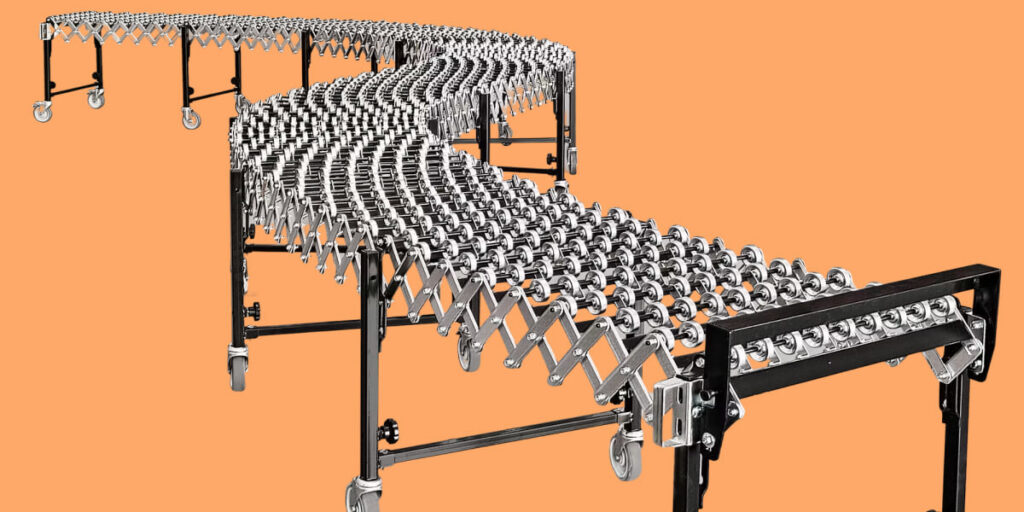
Flexible and Expandable Gravity Conveyors
These are accordion-style frames on casters that stretch, shrink and bend. They come in both skatewheel and roller versions. Shipping docks lean on them for loading and unloading trucks. When the job is done they fold down and roll out of the way.
Ball Transfer Tables
Ball transfer tables use a surface of steel or nylon balls. Workers can push product in any direction. They show up at merge points and workstations where items need to be turned or repositioned.
Gravity Chutes and Spiral Chutes
Chutes send product down to a lower level. Spiral chutes save floor space when you need to drop cartons between floors or off a mezzanine.
Gravity Conveyor Curves, Spurs, and Accessories
Most gravity conveyor lines also include:
- 45° and 90° curves
- Spurs for merging or splitting lines
- Hinged gates for walkways
- Guard rails and end stops
Roller Gravity Conveyors vs. Gravity Skatewheel Conveyors: Which Should You Choose?
| Factor | Roller | Skatewheel |
| Load capacity | Medium to heavy | Light to medium |
| Product bottoms | Flat or uneven | Smooth and flat only |
| Slope needed | More | Less |
| Curves | Good | Excellent |
| Unit weight | Heavier | Lighter and more portable |
| Cost | Higher | Lower |
| Best for | Heavy cartons, totes, drums, bags | Light cartons, empty boxes, flexible truck loading |
A simple guideline from Mallard Manufacturing: over 75 lbs. go with rollers. Under 50 lbs. skatewheels may be enough.
When Are Gravity Conveyors Used?
Common Gravity Conveyor Applications in Material Handling
- Truck loading and unloading
- Shipping and receiving
- Packing and kitting stations
- Assembly lines
- Accumulation zones between powered conveyors
- Carton flow in pick areas
- Moving cased product toward palletizing
In pharmaceutical and medical device plants they usually sit at the end of the line. They move sealed cases toward shipping. Primary containers such as vials and syringes are a different story. Those need powered handling with tight spacing and controlled speed to feed filling, labeling and inspection equipment.
How to Tell if a Gravity Conveyor Is Right for Your Facility
A gravity conveyor is likely a good fit if you can check most of these boxes:
- [ ] Products have firm and flat bottoms.
- [ ] Items weigh enough to roll but not so much they become hard to stop.
- [ ] Product moves level or downhill.
- [ ] Runs are short to moderate.
- [ ] Throughput doesn’t depend on exact timing or spacing.
- [ ] Workers are nearby to push or unload product.
- [ ] You want low cost with little or no maintenance.
- [ ] You need a setup that can move or expand later.
When a Gravity Conveyor Isn’t the Right Fit
- Product needs to go uphill.
- The line needs set speed or precise gaps between items.
- Products are fragile or unstable and could tip or collide.
- Items are tiny or very light and won’t roll reliably.
- The operation is high volume and automated from end to end.
Who Are the Top Gravity Conveyor Manufacturers?
Hytrol
Hytrol is based in Jonesboro, Arkansas and has been in business for more than 75 years. It offers a deep lineup of roller and skatewheel gravity models in steel and aluminum. Hytrol sells through a network of integration partners rather than direct.
Ashland Conveyor
Ashland is now part of ProVeyance. It’s known for a large catalog of standard gravity roller conveyors, with roller diameters from 3/4″ up to 2-5/8″.
Omni Metalcraft
Omni Metalcraft is based in Alpena, Michigan. It builds gravity roller conveyors along with lifts and tilters. Its conveyors are widely available through distributors.
Roach Conveyors
Roach started in 1953 in Trumann, Arkansas building cotton-handling equipment. It moved into package handling in 1969. Today it builds a broad line of American-made gravity and powered conveyors.
FMH Conveyors (Best Flex and NestaFlex)
FMH is also based in Jonesboro and is part of Duravant. It makes the Best Flex and NestaFlex lines of flexible and expandable gravity conveyors. You’ll see them on a lot of shipping docks.
How to Choose a Material Handling Conveyor Manufacturer
- Load ratings: Confirm capacity per foot and per section for your heaviest product.
- Standard sizes: Stock widths and lengths ship faster and cost less.
- Local support: Most brands sell through distributors. A good local partner matters for layout and parts.
- Compatibility: Make sure curves, spurs and stands match your existing line.
- Lead time: Standard gravity sections often ship quickly. Custom builds take longer.
How Much Do Gravity Conveyors Cost?
Gravity conveyor is one of the least expensive ways to move product. Prices vary by build and seller. Here’s what listed prices looked like in September 2026.
Gravity Conveyor Price Ranges by Type
| Type | Example listed price | Rough cost per foot |
| New roller gravity conveyor (18″–24″ W × 10′ L) | About 400–450 (WH1) | 40–45 |
| Galvanized roller conveyor (18″ W × 8′ L, 1.9″ rollers) | About $855 (Titans Packaging) | About $105 |
| Used roller gravity conveyor | About 170–300 per section (WH1) | Lower than new |
| Expandable skatewheel (18″ W, 3’–12′ L) | About 1,200–1,450 (Ultimation) | N/A |
| Large flexible units (30″ W, 40’+ L) | Quote only | N/A |
Custom and engineered systems are quoted by the project. Accessories and installation add to the total.
Factors That Affect Gravity Conveyor Cost
- Width: Wider frames cost more.
- Roller diameter and spacing: Bigger rollers set closer together raise capacity and price.
- Frame material and gauge: Heavier steel costs more than light aluminum.
- Roller finish: Galvanized and stainless rollers cost more than plain steel.
- Supports: Adjustable stands cost more than fixed ones.
- Accessories: Curves, gates, guard rails and brakes all add cost.
- New vs. used: Used sections can save a lot for simple layouts.
- Installation: Most gravity conveyor bolts together. Large systems may still need an integrator.
Gravity vs. Powered Conveyor Cost: Total Cost of Ownership
Gravity conveyor wins on cost at almost every stage:
- Purchase: It has no motors, drives or controls.
- Installation: It needs no electrical work.
- Operation: It uses no energy.
- Maintenance: Upkeep is mostly replacing an occasional worn roller or bearing.
The tradeoff is control. If manual handling slows the line or you need steady speed, a powered conveyor can pay for itself in labor savings.
Gravity Conveyor FAQs
How much slope does a gravity conveyor need? Not much. Roller conveyors often need only about a 1% grade. Skatewheels need even less. Test with your real product and adjust from there.
How much weight can a gravity conveyor hold? It depends on the build. Skatewheel conveyors commonly handle about 50 to 75 lbs. per foot. Roller conveyors often handle 100+ lbs. per foot. Always check the manufacturer’s rating.
Can gravity conveyors go around curves? Yes. Both roller and skatewheel conveyors come with curved sections. Skatewheel curves tend to handle cartons more smoothly.
Can you connect a gravity conveyor to a powered conveyor? Yes. This is common. Gravity sections often serve as accumulation or transfer zones at the end of a powered line.
Is a Gravity Conveyor Right for Your Material Handling Operation?
A gravity conveyor makes sense when products roll well and move level or downhill. It also fits when simplicity matters more than precise control. It costs little and takes almost no upkeep. It’s also easy to rearrange as your facility changes.
If you need speed control or automated timing, pair gravity sections with a powered conveyor. That way each part of the line does what it does best.





![[2026 Rankings] - Best Accumulation Tables and Accumulation Conveyors By Application (1)](https://dabrico.com/wp-content/uploads/2026/07/2026-Rankings-Best-Accumulation-Tables-and-Accumulation-Conveyors-By-Application-1.jpg "[2026 Rankings] - Best Accumulation Tables and Accumulation Conveyors By Application (1)")