Our Evaluation Process
Selecting the right automated visual inspection system is one of the most consequential capital equipment decisions in injectable pharmaceutical manufacturing. The inspection machine sits between your filling line and your patient, and its performance directly determines batch release timelines, false rejection costs, and regulatory confidence.
This guide evaluates automated visual inspection systems from five leading vendors, Koerber, Stevanato Group, Syntegon, Brevetti CEA, and Dabrico, across a standardized set of criteria.
Our evaluation framework considers six dimensions:
- Throughput and scalability
- Container format versatility
- Inspection technology depth
- Accuracy
- False reject rates
- Ease of qualification and validation
We weighted each dimension according to its relevance for the specific production scenario under review: high-volume lines demand speed and uptime, while medium- and low-volume operations place a premium on flexibility, recipe changeover speed, and ease of validation. All data in this guide is drawn from first-hand experience and vendor-published materials, including product pages, technical articles, and press releases. Where technical details are not publicly disclosed, we note them as unspecified.
How to Choose an Automated Visual Inspection System
Before diving into machine-by-machine comparisons, it is worth establishing the decision framework that should guide your selection. Automatic inspection machines are not interchangeable, and each platform reflects distinct engineering trade-offs between speed, flexibility, inspection depth, and footprint.
Start With Your Container Format and Production Volume
The single most important filter is matching the machine to your primary container type (vials, syringes, ampoules, or cartridges) and your throughput requirement. High-volume vaccine manufacturers filling 36,000 units per hour need fundamentally different equipment than a biotech running clinical-stage batches of a few thousand units.
Evaluate the Product Inside the Container
Water-like liquids are relatively straightforward to inspect. Suspensions, viscous biologics, lyophilized cakes, and oily solutions each present unique challenges. Vendors differentiate most sharply on these difficult-to-inspect products.
Determine Your CCIT Strategy
Regulatory expectations around container closure integrity testing have tightened under updated EU GMP Annex 1 guidelines. Most vendors now offer integrated HVLD for liquid products and headspace gas analysis for lyophilized products. Decide whether you want CCIT integrated into the inspection machine or as a separate downstream unit.
Assess AI Readiness
AI-powered pharmaceutical inspection is rapidly maturing. Several vendors now offer deep learning modules to supplement existing machine vision workflows, reducing false eject rates by orders of magnitude. If your current false-rejection rate is a significant cost driver, AI capabilities should weigh heavily in your evaluation.

Clear Liquid Vials
Best Automated Inspection Machines for High-Volume Vial Production
High-volume vial lines typically operate at 300–600+ containers per minute and require inspection platforms that maintain detection performance at speed without creating bottlenecks. The following automated inspection systems lead this category:
| Rank | Machine / Vendor | Max Speed | Container Types | Key Differentiator |
|---|---|---|---|---|
| 1 | Koerber Seidenader VI | 600/min | Vials, ampoules, cartridges | Up to 13 camera stations; Bubble-X and 3D inspection; HVLD Slim and UpsideDown integration |
| 2 | Brevetti K32S | 600/min | Vials, ampoules, cartridges | Three dedicated particle stations; dynamic bottom view via hollow spindles; high frame rate imaging |
| 3 | Syntegon AIM 9 | 600/min | Vials (up to 250 ml) | Patented Static Division technology; area and line-scan cameras; optional deep learning and bubble masking |
| 4 | Stevanato MAVIS | 400/min | Vials, cartridges, syringes | Patented imaging for suspensions and viscous products; up to 20 inspection stations; integrated HVLD and HGA |
At the highest throughput tier, Koerber, Brevetti, and Syntegon all achieve 600 containers per minute. Koerber’s Seidenader VI offers the most camera stations (up to 13), providing maximum flexibility for complex inspection recipes. Brevetti’s K32S inspection system stands out for its dynamic bottom-view capability through hollow spindles, a design particularly valuable for vaccine and suspension inspection. Syntegon’s AIM 9 brings patented Static Division particle inspection with the option to add AI-based deep learning. Stevanato’s MAVIS, while rated at a lower top speed, compensates with exceptional inspection depth and patented technology for difficult products.
Best Automated Inspection Machines for Medium and Low Volume Vial Production
Operations running fewer than 200 containers per minute benefit from platforms that prioritize flexibility, fast changeover, and streamlined validation over raw speed.
| Rank | Machine / Vendor | Max Speed | Container Types | Key Differentiator |
|---|---|---|---|---|
| 1 | Dabrico DAI-50 | 90/min | Vials (1 ml–1,000 ml) | AVIS unsupervised AI; 60-min recipe training; <6-week qualification; <1% false eject rate |
| 2 | Koerber Switch 75 | 75/min | Vials, syringes | Dual carousel for vials and syringes; 12 camera stations; AI-ready (B.R.AI.N); integrated de-/renester |
| 3 | Stevanato Plus 200 | 200/min (12,000/hr) | Vials, ampoules, cartridges | Index motion; motorized spindles; integrated HVLD on LKD model; compact footprint |
| 4 | Brevetti A50-150 | 150/min | Vials, ampoules, cartridges | Modular design up to 52 mm diameter; customizable optical configurations; hollow spindle bottom view |
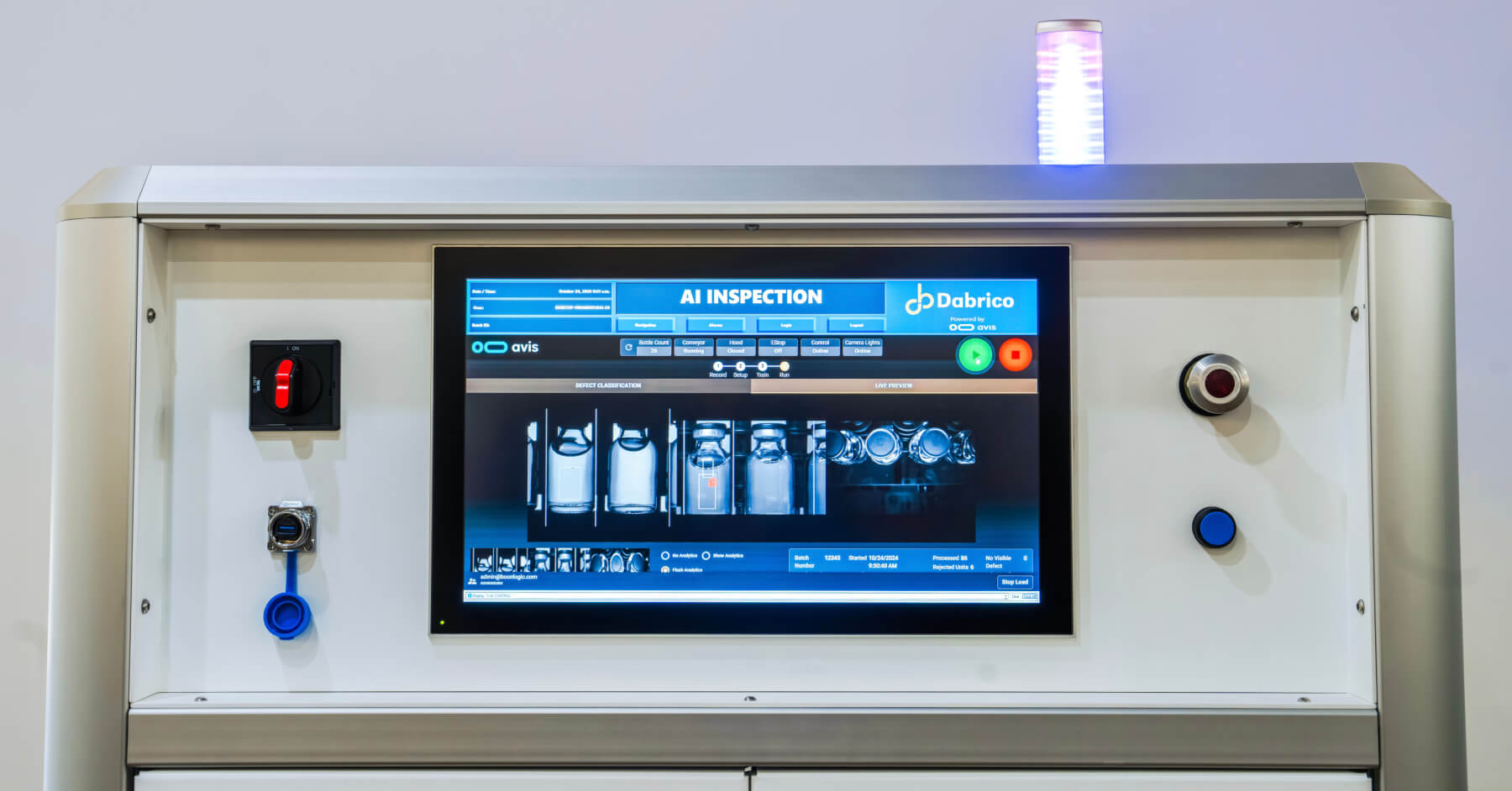
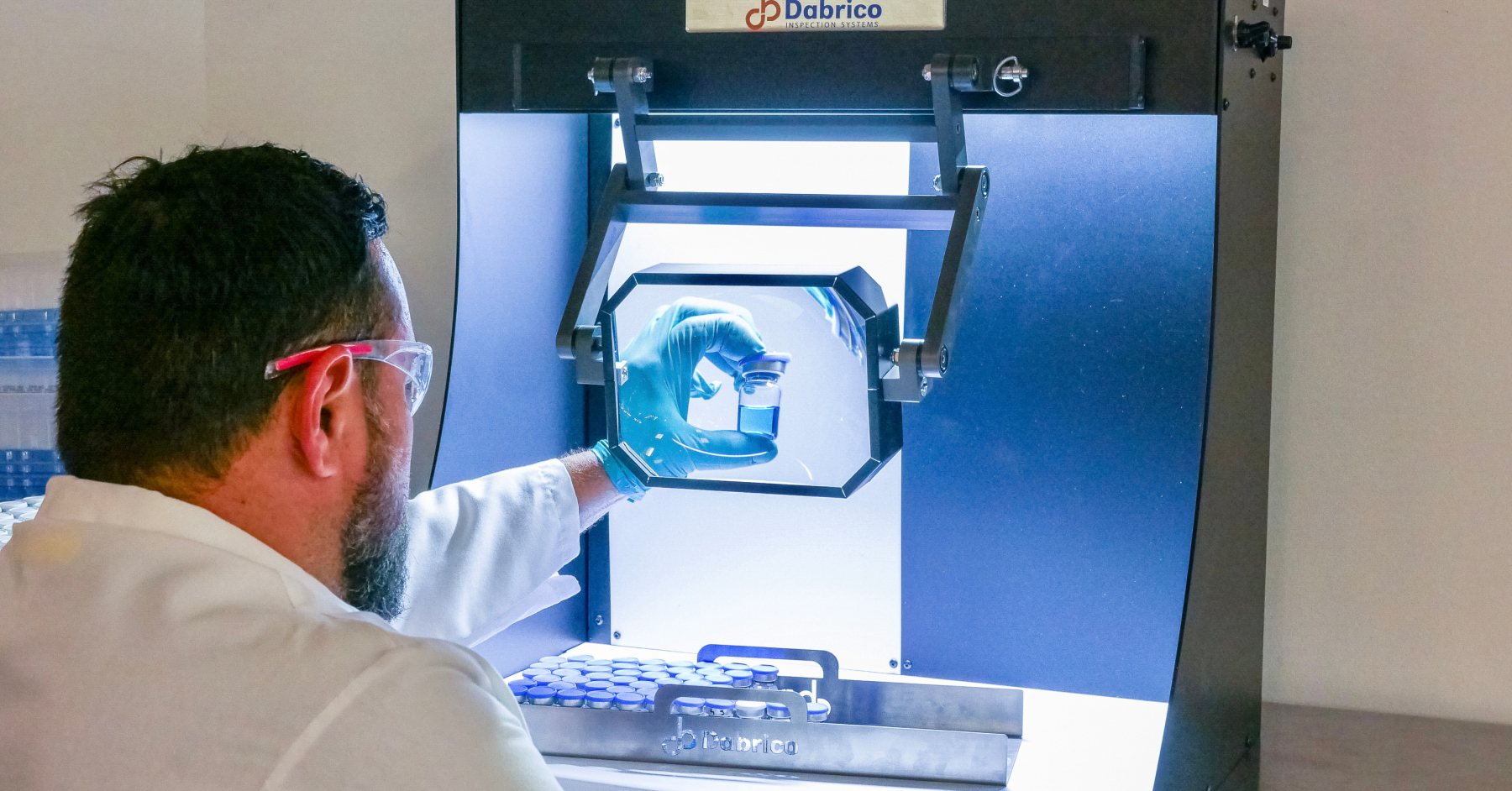
The Dabrico DAI-50 redefines what is achievable for medium and low-volume vial production. Powered by Boon Logic’s AVIS platform, the DAI-50 uses unsupervised machine learning to train a new inspection recipe by modeling normal product variation (no defect libraries or labeled datasets required). This fundamentally accelerates qualification, with most sites reaching GMP readiness in under six weeks. At up to 90 units per minute, with near-100% detection accuracy and a false eject rate below 1%, the DAI-50 delivers automated performance that matches or exceeds that of many larger systems, but with dramatically less setup, ongoing support, and cost. The platform’s ability to handle containers from 1 ml to 1,000 ml on a single machine makes it exceptionally versatile for facilities managing diverse SKU portfolios.
Koerber’s Switch 75 is the strongest alternative for operations that need to inspect both vials and syringes on a single platform. Its dual-carousel design and 12 camera stations provide substantial inspection depth at up to 75 containers per minute, and B.R.AI.N AI readiness offers a future upgrade path for false-reject optimization.

Syringes
Best Automated Inspection Machines for High-Volume Syringe Production
Pre-filled syringe inspection demands specialized handling to prevent glass-to-glass contact, eliminate bubble generation during transport, and inspect both the drug product and the needle shield or tip cap. High-volume syringe lines often require integrated de-nesting and re-nesting capabilities.
| Rank | Machine / Vendor | Max Speed | Container Types | Key Differentiator |
|---|---|---|---|---|
| 1 | Brevetti K15 DR | 600/min | Syringes (glass and plastic) | Zero-contact handling; integrated tub-and-nest cycle; no worm screws; gap compensation after rejection |
| 2 | Koerber Seidenader VI-S | 600/min | Syringes | Up to 10 camera stations; HVLD integration into carousel; Bubble-X and 3D inspection; Eject-X ready |
| 3 | Syntegon AIM DIRect | 400/min | Pre-filled syringes (RTU) | Fully automated de-nest/inspect/re-nest; scratch-free handling; gap compensation |
| 4 | Stevanato Easy 200 SY | 200/min (12,000/hr) | Syringes | Index motion; cap/needle/plunger/flange inspection; compact in-line footprint; 21 CFR Part 11 |
Brevetti’s K15 DR inspection system leads the syringe category with its zero-contact handling system, which entirely eliminates worm screws from the design to prevent friction, bubble formation, and glass damage. The integrated tub-and-nest cycle handles de-nesting, inspection, and re-nesting in a single compact footprint. Koerber’s VI-S matches the 600-per-minute speed with deep camera integration and HVLD for closure integrity.
Best Automated Inspection Machines for Medium and Low Volume Syringe Production
| Rank | Machine / Vendor | Max Speed | Container Types | Key Differentiator |
|---|---|---|---|---|
| 1 | Dabrico DAI-50 | 90/min | Syringes, vials, ampoules | Single platform for all formats; AVIS unsupervised AI; 60-min recipe training; <6-week qualification |
| 2 | Koerber Switch 75 | 75/min | Syringes, vials | Dual-carousel flexibility; integrated nester; 12 camera stations; B.R.AI.N AI-ready |
| 3 | Stevanato Easy 200 SY | 200/min (12,000/hr) | Syringes | Index motion; comprehensive syringe-specific inspections; compact footprint |
| 4 | Brevetti K15 | 600/min | Syringes | No-contact option; manual loading or in-line; same Intelligent Vision Framework as K15 DR |
For facilities that do not require 400+ syringes per minute, the DAI-50 offers a compelling alternative. Its single-platform versatility means the same machine that inspects vials in the morning can inspect syringes in the afternoon. The DAI-50 is particularly valuable for syringe inspection, where product variability (bubbles, plunger position, needle shield alignment) creates complex normal variation that traditional rule-based systems struggle to parameterize efficiently.
Koerber’s Switch 75 again earns a strong position here, offering integrated de-/re-nesting alongside its dual-carousel design—a meaningful advantage for nested syringe formats that would otherwise require a separate handling system.

Ampoules
Best Automated Inspection Machines for High-Volume Ampoule Production
Ampoule inspection at high speed requires reliable leak detection and careful handling of sealed glass containers.
| Rank | Machine / Vendor | Max Speed | Container Types | Key Differentiator |
|---|---|---|---|---|
| 1 | Koerber Seidenader VI | 600/min | Ampoules, vials, cartridges | 13 camera stations; Bubble-X bubble discrimination; HVLD Slim with UpsideDown for low-fill ampoules |
| 2 | Brevetti K32S | 600/min | Ampoules, vials, cartridges | High frame rate imaging; three particulate stations; dynamic bottom view; oily solution support |
| 3 | Syntegon AIM 9 | 600/min | Vials, ampoules | Patented SD technology; integrated HVLD and HSA options; built-in reinspection |
| 4 | Stevanato Plus 400 | 400/min (24,000/hr) | Ampoules, vials, cartridges | Continuous motion; movable arm camera synchronization; servo-driven defect separation |
Koerber’s UpsideDown module in the Seidenader VI is particularly relevant here as it inverts the ampoule to redistribute liquid for thorough HVLD sidewall coverage, which is critical for low-fill or high-viscosity ampoule contents. Brevetti’s K32S takes the runner-up in this category as it can support oily solutions and suspensions with its dynamic bottom-view approach.
Best Automated Inspection Machines for Medium and Low Volume Ampoule Production
| Rank | Machine / Vendor | Max Speed | Container Types | Key Differentiator |
|---|---|---|---|---|
| 1 | Brevetti A35 | 300/min | Ampoules, vials, cartridges | Compact design; 8–32 mm diameter range; optional HVLD (A35 LD); white LED lighting |
| 2 | Brevetti A50-150 | 150/min | Ampoules, vials, cartridges | Modular; handles up to 52 mm diameter; customizable optics; HGA option for lyo |
| 3 | Stevanato Plus 200 | 200/min (12,000/hr) | Ampoules, vials, cartridges | Index motion; compact footprint; integrated HVLD on LKD model |
Brevetti’s A35 is a strong choice, striking an effective balance between compactness and capability. Its 8–32 mm diameter range covers the vast majority of ampoule formats, and the A35 LD variant integrates high-voltage leak detection directly into the inspection machine—eliminating the need for a separate CCI station and saving valuable floor space. At 300 pieces per minute, it also bridges the gap between true low-volume and mid-volume operations. The Brevetti A50-150 offers additional flexibility for facilities that need to handle larger containers (up to 52 mm), with customizable optical configurations and a headspace gas analyzer option for lyophilized ampoule products. Stevanato’s Plus 200, with its proven index motion technology and available HVLD integration on the LKD model, remains a reliable option for operations prioritizing straightforward, well-established inspection workflows with a compact footprint.
Difficult-to-Inspect Injectables
Suspensions, highly viscous drugs, lyophilized products, and emulsions are among the most challenging injectable pharmaceutical products to inspect. These products challenge every aspect of the inspection process: particles are obscured by opaque media, bubbles behave unpredictably in viscous solutions, and lyo cake surfaces exhibit natural variation that can resemble both true defects and cosmetic defects. This is the category where inspection technology, not just mechanical throughput, determines success.
| Rank | Machine / Vendor | Max Speed | Container Types | Key Differentiator |
|---|---|---|---|---|
| 1 | Dabrico DAI-50 | 90/min | Vials, syringes, ampoules (1 ml–1,000 ml) | AVIS unsupervised learning models real-world variation in suspensions, viscous products, and molded glass; detects unknown defects without defect libraries; <1% false eject rate |
| 2 | Stevanato MAVIS | 400/min | Vials, cartridges, syringes | Patented imaging for suspensions and viscous products; matrix and line-scan cameras; integrated HVLD and HGA; AI available |
| 3 | Koerber Seidenader VI | 600/min | Vials, ampoules, cartridges | Bubble-X refraction-based discrimination; 3D inspection for viscous drugs; B.R.AI.N AI |
| 4 | Brevetti K32S | 600/min | Vials, ampoules, cartridges | Particle Trajectory Tracking; supervised bubble filtering; 100 images per particle unit; dynamic bottom view |
| 5 | Syntegon AIM 9 | 600/min | Vials | SD technology; bubble masking tool; optional deep learning; area and line-scan cameras |
Based on our research, the DAI-50 is the strongest contender in this category. While it operates at a lower throughput than traditional high-speed systems, it makes up for it in accuracy and flexibility. Alternative high-speed systems rely on increasingly complex combinations of optics, rule-based algorithms, and supervised AI models. These approaches can improve performance, but they are still constrained by a core limitation: they can only detect what they are explicitly programmed or trained to find.
The DAI-50 takes a different approach. Powered by AVIS, it learns the full spectrum of acceptable variation directly from production. Instead of tuning the model for specific defect types, it flags any deviation from normal, including previously unseen defects.
Among the alternative systems, Stevanato’s MAVIS stands out for its specialized imaging in suspension-heavy products, while Koerber’s Bubble-X provides a strong physics-based approach to bubble discrimination. Brevetti and Syntegon offer increasingly sophisticated multi-method detection stacks. But all rely, to varying degrees, on predefined rules or labeled defect data—approaches that become increasingly difficult to scale as product complexity increases.
Full Rankings of Best Automated Visual Inspection Machines
The following consolidated ranking reflects overall capability across container formats, product complexity, inspection technology depth, AI sophistication, validation efficiency, and adaptability. High-volume visual inspection platforms are assessed alongside flexible systems to provide a complete market view.
| Rank | Machine / Vendor | Max Speed | Container Types | Key Differentiator |
|---|---|---|---|---|
| 1 | Dabrico DAI-50 | 90/min | Vials, syringes, ampoules (1 ml–1,000 ml) | AVIS unsupervised AI; 60-min recipe training; <6-week qualification; 99% accuracy; <1% FER; handles lyo, suspensions, viscous, and powders on a single platform |
| 2 | Koerber Seidenader VI | 600/min | Vials, ampoules, cartridges | Industry-leading 13 camera stations; Bubble-X discrimination; B.R.AI.N AI; HVLD Slim + UpsideDown; DE.SY.RE gentle handling up to 1,000/min |
| 3 | Brevetti K32S | 600/min | Vials, ampoules, cartridges | Particle Trajectory Tracking; 100 images per particle unit; hollow-spindle bottom view; Intelligent Vision Framework with supervised bubble filtering |
| 4 | Syntegon AIM 9 | 600/min | Vials (up to 250 ml) | Patented Static Division; area and line-scan cameras; bubble masking; optional deep learning; integrated HVLD and HSA |
| 5 | Stevanato MAVIS | 400/min | Vials, cartridges, syringes | Patented suspension imaging; 20 inspection stations; matrix and line-scan cameras; cloud-based Vision AI; integrated HVLD and HGA |
| 6 | Brevetti K15 DR | 600/min | Syringes | Zero-contact syringe handling; integrated tub-and-nest; compact integrated line |
| 7 | Koerber Switch 350 | 350/min | Vials, syringes | Combined vial/syringe platform; 33+ stations; replaces two machines with one |
| 8 | Stevanato Plus 400 | 400/min (24,000/hr) | Vials, ampoules, cartridges | Continuous motion; 35 KV HVLD; movable-arm camera synchronization; turbidimeter integration |
The DAI-50 earns the top overall ranking from its consistent performance across all three product categories. Koerber Seidenader VI platform takes runner-up honors for its depth of inspection technologies and unmatched scalability ceiling, from 600 containers per minute on the standard carousel to 1,000 per minute with the DE.SY.RE 1000 pathway, giving large-volume manufacturers the most room to grow without re-platforming.
Conclusion
Pharmaceutical manufacturing is undergoing a structural shift. The growth of biologics and specialty drug products is introducing a new generation of complex formulations that are inherently more difficult to inspect. Traditional automated visual inspection systems were designed for clear liquid products with consistent, predictable appearance profiles. As product variability increases, these systems struggle to differentiate acceptable variation from true defects, leading to elevated false reject rates and reduced efficiency.
As a result, inspection performance is no longer defined solely by mechanical throughput or camera count, but by the system’s ability to model real-world product variation. Manufacturers evaluating vision inspection systems for pharmaceuticals should prioritize solutions that move beyond rigid, rule-based approaches and instead leverage AI-driven anomaly detection to improve both sensitivity and specificity. Reducing false rejects while maintaining high defect detection is critical—not only for yield and cost control, but for ensuring consistent product quality and maximizing patient safety.


![[2026 Rankings] - Best Accumulation Tables and Accumulation Conveyors By Application (1)](https://dabrico.com/wp-content/uploads/2026/07/2026-Rankings-Best-Accumulation-Tables-and-Accumulation-Conveyors-By-Application-1.jpg "[2026 Rankings] - Best Accumulation Tables and Accumulation Conveyors By Application (1)")