
AI-Powered AUTOMATIC INSPECTION
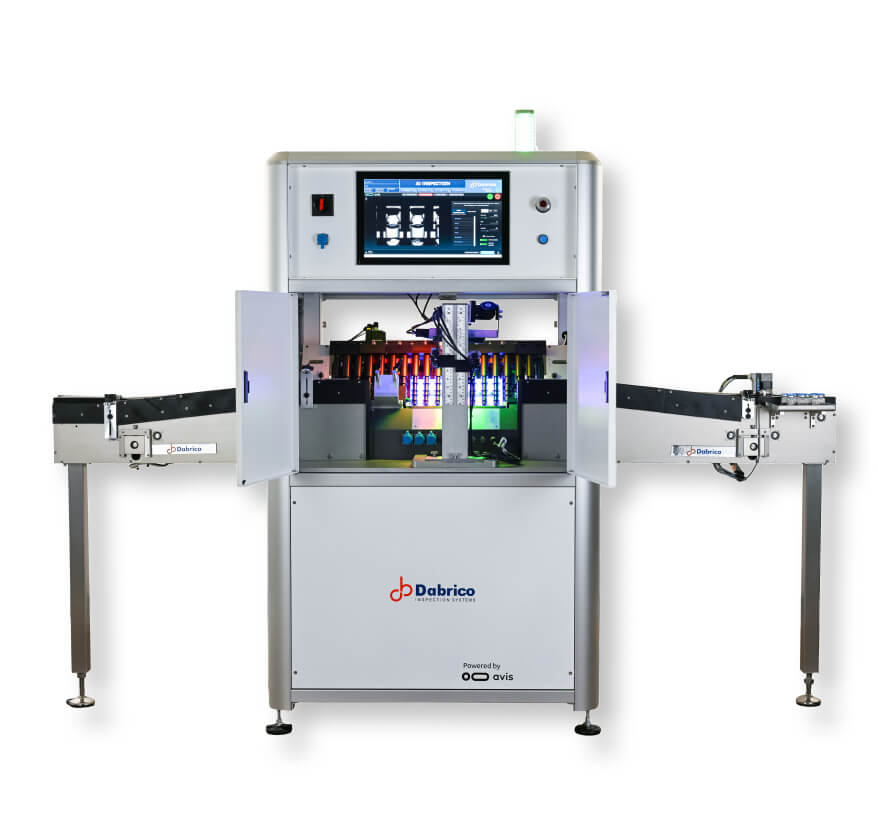
Enhance product quality and 3X inspection speed with the DAI-50
The DAI-50 brings together Dabrico’s 45 years of automated visual inspection expertise and Boon Logic’s AVIS AI platform to set a new standard of inspection: human-like adaptability with validated, automated performance.
60-minutes to train an inspection recipe
90 units per minute at maximum speed
99% detection accuracy for particulate and cosmetic defects*


Inspection Technologies Features
A Superior Approach to Pharma Automated Visual Inspection
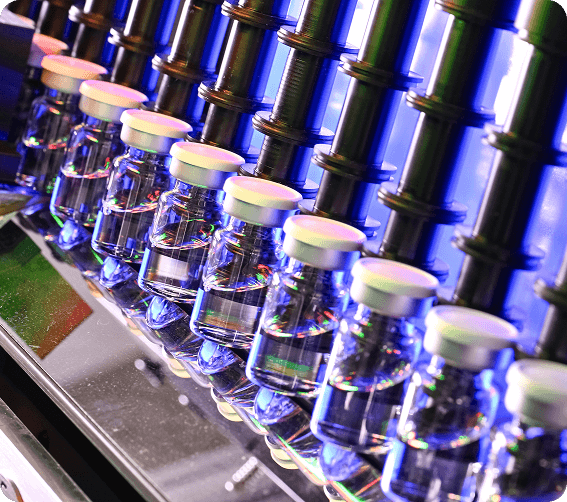
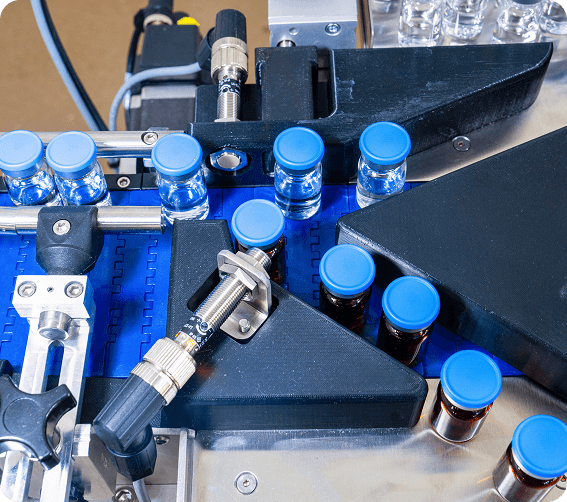
Fast and gentle material handling to support any form factor
The DAI-50 uses a brief pre-spin to create a controlled vortex that makes particles easier to detect. This ensures every defect is clearly captured by one of the system’s three high-resolution cameras.
- Adjustable pre-spin for full defect visibility
- Adjustable lighting and vial positioning
- Interchangeable rollers to support any product type
- Configurable for 2 ml – 1,000 ml containers
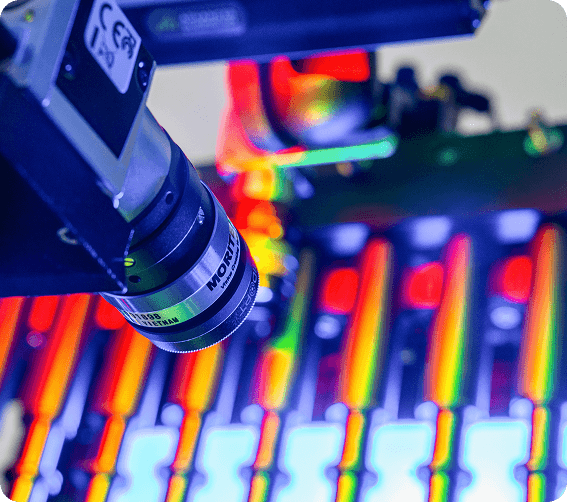
Configurable optics for maximum visibility
The DAI-50 uses three dedicated cameras, each focused on different parts of the vial to highlight specific defect types. Pre-defined regions of interest (ROIs) guide each camera to the areas where issues most commonly occur, providing clear, targeted insight for accurate inspection.
- Backlit camera
- Top-view camera
- Side-view camera
- 60 frames per second

Artificial intelligence-based visual inspection powered by AVIS
AVIS uses an unsupervised learning approach that models normal variation rather than relying on defect libraries or labeled images, allowing it to detect both known and unknown anomalies.
This method naturally adapts to real-world variability in molded glass vials, powders, lyo cakes, and other challenging products. In 45 minutes and four simple steps, a new inspection recipe can be created.
- Near 100% accuracy for all defect types
- <1% false eject rate
- Train new inspection recipes in <60-minutes
Seamless system qualification with audit-friendly documentation.
The DAI-50 follows the standard pharma validation sequence IQ, OQ, and PQ but accelerates qualification because AVIS trains directly from compliant product and creates a frozen, validation-ready recipe.
- Audit-validated qualification process
- Full documentation and qualification support
- <6-weeks to qualify on average
Pharmaceutical Industry Use Cases
Never miss a defect, even with
difficult-to-inspect products

Freeze-dried products
Lyophilized products, such as vaccines and certain antibiotics, pose unique inspection challenges because natural variation in appearance can closely resemble true defects. By learning normal product variation directly from compliant units, the DAI-50 avoids rigid defect rules and instead flags only meaningful anomalies—delivering reliable detection without mistaking acceptable variability for defects.

Milky products
Camera-based inspection is well suited for opaque or milky formulations like propofol, where inherent variability can obscure true defects. By modeling normal appearance from compliant product and combining controlled imaging, rotation, and optimized lighting, the DAI-50 improves detection accuracy while minimizing false rejects driven by acceptable product variation.

Bubble-prone products
Protein-based formulations often produce bubbles that closely resemble defects during inspection. By learning normal bubble behavior from compliant product, the DAI-50 distinguishes harmless bubbles from true contaminants, improving inspection accuracy while reducing unnecessary rejects.

Suspensions
Suspended products like insulins and certain vaccines are more difficult to inspect than clear solutions due to inherent visual variability. By combining controlled rotation with optimized imaging and learning normal product behavior from compliant units, the DAI-50 makes true contaminants easier to detect without increasing false rejects.

Water-like products
Clear, water-like solutions such as vaccines or GLP-1 products require extremely sensitive inspection to detect small particulates. By learning normal optical behavior from a compliant product and combining high-resolution imaging with configurable lighting from multiple angles, the DAI-50 delivers reliable detection with minimal false rejects.

Recipe Creation Process
Train a new Visual inspection recipe
in minutes
The first step in creating a new inspection recipe in AVIS is to record 500 pre-inspected compliant units, covering normal product variations like powder disposition, bubbles, fill level, glass molding, and more. AVIS uses three cameras, capturing hundreds of images from the top, inside, and outside of each unit at 60 frames per second per camera.
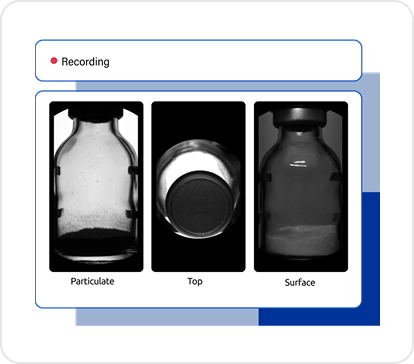
After recording, configure regions of interest (ROIs) for all three cameras. Since the units rotate 360 degrees, ROIs can be positioned in areas prone to defects, including easy-to-inspect features like the side wall and shoulder, as well as challenging areas like the vial base, oblique views of lyo cakes and powder, and tamper-evidence seals.
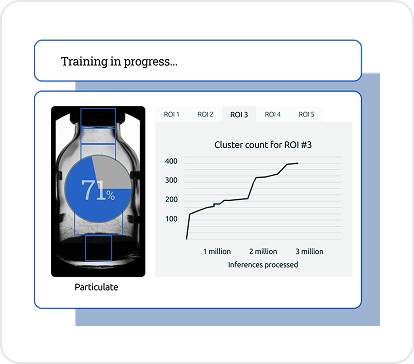
AVIS uses Boon Logic’s unsupervised machine learning algorithm, Boon Nano, to learn the normal variation for each Region of Interest (ROI). A learning curve tracks the model’s progress for each ROI. Initially, the curve is steep as AVIS learns significant variations, but it levels off toward the end, indicating that most normal variations have been integrated into the recipe. Ten unique models are trained, one for each of the 10 ROIs.
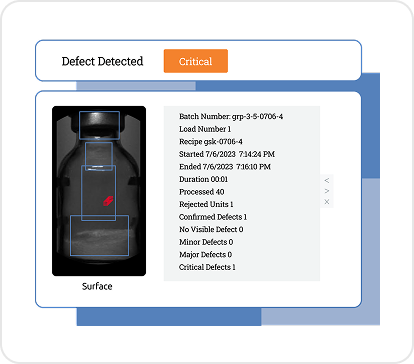
In run mode, AVIS makes 100,000 machine learning inferences per vial. Anomalies outside the learned normal variation trigger a spike in the anomaly index, indicating a potential defect. AVIS determines whether a unit is defective within milliseconds, triggering actions like ejecting the unit, stopping the conveyor, or flashing a light. The defect’s video frame, with the exact location highlighted, is displayed and archived for trend analysis.
Automated Vision Inspection Solutions
Reimagine Pharma Automatic Visual Inspection with the DAI-50
The future of automated visual inspection isn’t about choosing between the flexibility of human inspectors and the consistency of machines. It’s about obtaining both with artificial intelligence. The DAI-50 delivers an AI-powered inspection system that brings consistency, adaptability, and precision to modern quality control.
Traditional automated vision inspection (AVI) systems rely on rigid rules and predefined defect categories. The DAI-50 takes a different approach to automatic detection. It learns what “good” looks like and flags anything outside that pattern, enabling more reliable inspection across real-world production variability.
This transforms quality inspection systems by delivering:
- More accurate detection across complex products
- Consistent quality control without human variability
- Scalable performance for high-mix, low-volume environments
The result is a higher standard for machine vision inspection. One that elevates the inspection process from start to finish.
Schedule a demo and
see DAI-50 in action
Frequently Asked Questions
How does the DAI-50 compare to other automated vision inspection (AVI) systems?
The DAI-50 combines advanced automated vision with Dabrico’s AVIS inspection platform to simplify recipe development and improve inspection performance across challenging pharmaceutical products.
Key differences include:
- Unsupervised learning: AVIS models normal product variation instead of relying entirely on predefined defect libraries or labeled images.
- Detection of unknown anomalies: The system can identify both known defects and unexpected abnormalities that were not specifically programmed into the inspection recipe.
- Faster recipe creation: New inspection recipes can be created in as little as 45 minutes using a four-step process.
- Designed for difficult products: The DAI-50 can accommodate the natural variability found in molded glass vials, powders, lyophilized cakes, and other challenging injectable pharmaceutical products.
- Less manual configuration: Its automated inspection approach reduces the amount of defect-specific programming typically required by conventional automated visual inspection systems
What injectable pharmaceutical products can the DAI-50 inspect?
The DAI-50 is designed to inspect a wide range of injectable pharmaceutical products, including difficult products that can create challenges for conventional automated inspection systems. Dabrico has demonstrated the platform across both vials and syringes.
Container types include:
- Glass vials, including molded and tubular glass
- Prefilled syringes, including translucent plastic syringes
Product formats include:
- Clear, water-like liquids
- Milky or opaque liquids
- Suspensions
- Bubble-prone formulations
- Lyophilized (freeze-dried) cakes
- Powders
The DAI-50 can be configured for containers ranging from 2 mL to 1,000 mL, allowing pharmaceutical manufacturers to use the same automated inspection platform across a broad range of products and container formats.
Container types include:
- Glass vials, including molded and tubular glass
- Prefilled syringes, including translucent plastic syringes
Product formats include:
- Clear, water-like liquids
- Milky or opaque liquids
- Suspensions
- Bubble-prone formulations
- Lyophilized (freeze-dried) cakes
- Powders
The DAI-50 can be configured for containers ranging from 2 mL to 1,000 mL, allowing pharmaceutical manufacturers to use the same automated inspection platform across a broad range of products and container formats.
What inspection technologies are used in the DAI-50?
The DAI-50 combines advanced inspection technologies with Boon Logic’s AVIS platform to automate defect detection and product evaluation. Rather than relying only on predefined defect libraries, the system uses image and inspection data to model acceptable product variation and identify anomalies.
Core technologies include:
- AI-powered automated vision for identifying visible defects and abnormalities
- Unsupervised learning that learns normal product variation from inspection data
- High-resolution imaging for detailed analysis of containers and drug products
- Automated defect detection for consistent inspection decisions
- Recipe-based inspection controls that can be configured for different products and formats
- Inspection data collection to support process monitoring, review, and quality control
Together, these technologies allow the DAI-50 to perform consistent automated inspection across a wide range of pharmaceutical products, including challenging liquids, powders, and lyophilized products.
How does automated visual inspection improve pharmaceutical inspection?
Automated visual inspection improves pharmaceutical inspection by replacing repetitive manual checks with consistent, high-speed analysis. Modern automated visual inspection systems can evaluate every container using the same inspection criteria, helping manufacturers improve quality control while reducing operator variability.
Key benefits include:
- Greater consistency: Automated inspection machines apply the same inspection standards to every product.
- Higher throughput: Automatic inspection can evaluate large production volumes much faster than manual inspection.
- Improved defect detection: Advanced vision systems can identify particles, cosmetic defects, container abnormalities, and other quality concerns.
- Reduced human error: Automation minimizes the fatigue and subjectivity associated with repetitive manual inspection.
- Better traceability: Inspection results can be recorded and reviewed to support quality investigations and process improvement.
- More efficient production: Automated systems can integrate directly into pharmaceutical manufacturing workflows, reducing inspection bottlenecks.
For pharmaceutical manufacturers, automated visual inspection provides a more scalable and repeatable approach to maintaining product quality across high-volume production.
Can the DAI-50 integrate with filling, packaging, and other pharmaceutical production equipment?
Yes. The DAI-50 can be integrated into existing pharmaceutical production lines alongside filling, packaging, and other inspection equipment. This allows manufacturers to add automated inspection without redesigning the entire production process.
How long does it take to install and qualify the DAI-50 in an existing pharmaceutical plant?
The exact timeline depends on the facility, required integration, product complexity, and the manufacturer’s validation strategy. Much of the DAI-50 can be configured before delivery, so on-site work is focused primarily on installation, system integration, verification, and execution of the required IQ, OQ, and PQ activities.
The DAI-50 was designed to provide a faster and more predictable path to production than traditional AVI systems, which can require extensive on-site tuning and recipe development. AVIS further reduces this burden by creating inspection models directly from compliant product rather than requiring extensive defect libraries or prolonged rule tuning.
Because every pharmaceutical facility has different qualification requirements, we establish the expected installation and qualification schedule with the customer during project planning.
Does the DAI-50 perform container closure integrity (CCI) testing?
No, currently the DAI-50 does not perform container closure integrity (CCI) testing as an out-of-the-box feature.
What services are available after purchasing the DAI-50?
Our support does not end when the DAI-50 is delivered. Dabrico provides post-sale services to help manufacturers install, qualify, operate, and maintain their inspection system over the long term. This can include technical support, application support, qualification documentation, troubleshooting, and assistance as production requirements change. Whether you are introducing a new drug product, creating an inspection recipe, or adapting the system for a new application, our team remains available to support your operation. It is the same hands-on approach we have brought to customers across the pharmaceutical industry for decades.