“Essentially free” and “practically free from visible particles” describe the same broad goal: injectable drugs should be free from unwanted visible particles, while recognizing that inspection cannot detect every particle with perfect accuracy. “Essentially free” is used by the United States Pharmacopeia (USP), while “practically free” is used by the European Pharmacopoeia.
The difference lies in the standards behind the terms. Neither guarantees zero particles, automatically means a stricter requirement, or requires different inspection equipment. Manufacturers must follow the testing procedures and acceptance criteria that apply to their product.
Essentially Free and Practically Free at a Glance
“Essentially free” is the term used in the United States Pharmacopeia, usually shortened to USP. “Practically free” appears in the European Pharmacopoeia, often abbreviated as Ph. Eur. These publications set quality standards for medicines, including requirements related to unwanted particles in injectable products.
| Question | Essentially Free | Practically Free |
|---|---|---|
| Where is it mainly used? | United States Pharmacopeia | European Pharmacopoeia |
| What does it focus on? | Meeting the specified inspection and acceptance criteria | Meeting the quality requirement while recognizing the limits of manufacturing and inspection |
| Does it guarantee zero particles? | No | No |
| Does it automatically require different equipment? | No | No |
The two terms have more in common than their wording might suggest. Both sit within systems for inspecting products and judging whether batches meet the relevant requirements. You cannot tell which requirement is stricter simply by comparing the words “essentially” and “practically.” You need to look at the actual tests and acceptance criteria behind them.
What Essentially Free From Visible Particles Means
USP chapter 〈790〉 explains “essentially free” through a defined inspection process. When a product is inspected using the chapter’s procedure, the number of containers found to contain visible particles must stay within the specified acceptance limits. In plain English, there is a test and a set of rules for deciding whether the result passes.
That does not translate into a general allowance for particles in every vial. A rule about how many containers in a sample may show a defect is different from saying that each container can hold a certain number of particles. The distinction matters because a batch assessment and an individual vial inspection answer different questions.
Imagine reviewing an inspection report that simply says “essentially free.” You would still want to know which procedure was followed, how many containers were examined, and what the inspectors found. The phrase describes a quality conclusion, but the inspection records provide the evidence behind it. Without those details, the label tells you very little about how the product was assessed.
What Practically Free From Visible Particles Means
The European wording approaches the same challenge by recognizing a practical limitation: no inspection process can guarantee that it will find every particle. EDQM, the organization responsible for the European Pharmacopoeia, explains that the word “practically” reflects the capabilities of manufacturing and testing. The expectation remains that products should be free from unwanted visible particles.
There is still a process for showing that a batch meets the requirement. European guidance discusses inspecting every container, removing units with detected particles, and using acceptance sampling to assess the inspected batch. Acceptance sampling means checking a selected group of units against an established plan to help judge the quality of the batch.
This is why “practically free” should not be read as “clean enough by someone’s judgment.” It has a defined context within pharmaceutical quality standards. The relevant European references include the Parenteral Preparations monograph, 0520, and chapters 2.9.20 and 5.17.2. These explain the requirement, examination method, and supporting inspection guidance.
So What Is the Actual Difference
The clearest answer is that they express a similar quality goal within different sets of standards. USP directly defines “essentially free” by reference to its inspection and acceptance criteria. The European explanation of “practically free” highlights the limits of manufacturing and testing, while also using inspection and batch checks to assess compliance.
It would be an oversimplification to say that one approach measures results and the other simply accepts that inspection is imperfect. Both use evidence to support a quality decision. It would also be misleading to say the two phrases necessarily require completely different ways of inspecting a vial. The inspection approaches can overlap.
For a manufacturer, the practical question is which requirements apply to the product. A medicine intended for more than one market may need to meet multiple applicable standards. Changing “essentially” to “practically” in a document does not show that the product meets another market’s requirements. The supporting inspection process and results need to match those requirements.
Neither phrase is a shortcut around that work. Think of the wording as a reference to a larger set of rules. To understand what the statement means for a particular product, follow it back to the relevant specification and testing procedure rather than trying to interpret the adjective on its own.
Why Inspecting Every Vial Does Not Mean Finding Every Particle
“100% inspection” sounds like it should produce 100% certainty. In reality, it means every container goes through the inspection process. It does not mean every particle will be detected. This difference is central to understanding why pharmaceutical standards use qualified terms such as essentially free and practically free.
Some Particles Are Harder to See
Picture two otherwise similar vials. One contains a dark fragment that stands out against the liquid. The other contains a translucent particle that is much harder to distinguish. Even if the particles have similar dimensions, they may not be equally easy to detect. The product and container also affect what the inspector can see.
USP 〈1790〉 explains that particle detection depends on factors such as size, shape, color, and the container. A 2024 study involving nine biopharmaceutical companies reached a related finding: there is no single particle size that marks a reliable visibility limit for every particle type. Saying a particle is “visible” involves more than measuring its dimensions.
Inspection Coverage and Detection Are Different
Consider a hypothetical batch of 10,000 vials. If all 10,000 pass through an inspection station, the batch has received 100% inspection. That statement tells you how many vials were checked. To understand how well they were checked, you also need evidence about the process’s ability to detect the relevant defects.
This is a useful distinction when discussing inspection performance with a supplier or reviewing production records. “Every unit was inspected” and “the process consistently detects these defects under these conditions” are different claims. A good inspection program needs to address both. Our summary of USP 〈1790〉 explains how these principles fit into a broader inspection program.
What This Means for a Pharmaceutical Inspection Process
For day-to-day operations, visual inspection qualification helps establish a clear, repeatable process that supports the quality requirement. People need to know what they are looking for, how the inspection is performed, and what happens when a defect is found. They also need records that allow the quality team to understand the results and respond when something changes.
Use Conditions That Fit the Product
When evaluating an inspection setup, start with the product you actually make. A demonstration using one type of vial and liquid may not answer every question about a different container or formulation. Ask how closely the test conditions represent production and what evidence supports using the process for your application.
The same principle applies to defect examples. A demonstration is more useful when it includes the kinds of particles your process needs to detect. If the evidence focuses on only a narrow set of easy-to-see defects, ask what is known about the more challenging ones. That keeps the discussion focused on demonstrated performance.
Check the Batch and Understand the Results
Inspecting containers helps identify and remove defective units. Acceptance sampling provides a further check on the inspected batch. These activities work together, but they serve different purposes. For a quality review, it helps to keep both sets of results available so the reviewer can understand what was found during production and during the subsequent batch check.
Passing a sample check does not answer every question about the manufacturing process. FDA’s draft guidance on visible particles explains that meeting a pharmaceutical standard alone is generally insufficient to show compliance with all applicable manufacturing requirements. It also notes that some contamination can indicate serious problems even when a batch passes statistical acceptance criteria.
For example, imagine that a new type of fragment starts appearing in rejected vials. Even if a later sample passes, the new defect still raises useful questions: where did it come from, what changed, and could other units be affected? Investigating the cause helps the manufacturer address the problem at its source.
Choose Equipment Based on the Application
The terms “essentially free” and “practically free” do not determine whether a manufacturer should use manual, semi-automated, or automated visual inspection. The right approach depends on the product, container, expected defects, and production requirements. Pasted markdown
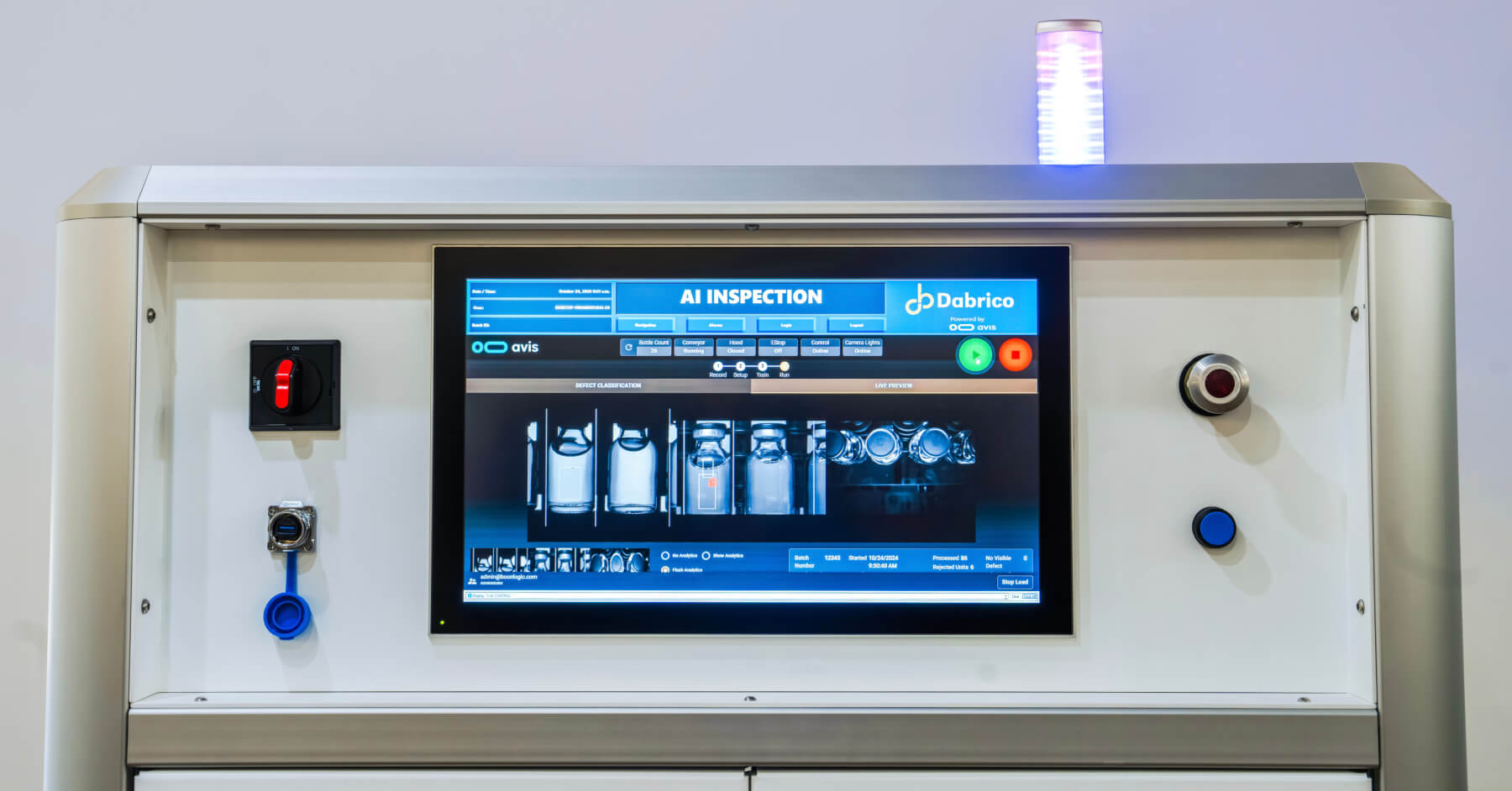
For manufacturers seeking greater confidence in product quality, the DAI-50 provides fully automated inspection powered by AVIS. Its unsupervised machine learning learns normal product variation and flags anomalies, making it well suited for challenging applications such as molded glass, lyophilized products, powders, suspensions, emulsions, and prefilled syringes.
Our goal is to help manufacturers establish a consistent, qualified inspection process they can trust.
Frequently Asked Questions
Is Essentially Free Stricter Than Practically Free
The terms alone do not establish that one is stricter. You need to compare the actual procedures and acceptance criteria that apply to the product. It is reasonable to say they share a similar quality goal, but that does not make every requirement interchangeable. The important comparison is between the standards and supporting evidence, rather than the two words.
Does Practically Free Mean a Few Particles Are Allowed in Each Vial
No. The phrase does not provide a universal particle allowance for individual vials. Certain biological products may have justified, product-specific provisions, but these need supporting evidence and must meet the applicable approval requirements. EMA discusses the need to understand the particles, assess their risk, and define acceptable batch results. Such provisions cannot be assumed for another product simply because it uses the same wording.
What About Particles Too Small to See
Subvisible particles are a separate testing concern. USP 〈788〉 describes methods that use light obscuration or microscopy to assess them. A product that passes visual inspection has not automatically passed its subvisible particle tests. Likewise, a satisfactory subvisible particle result does not tell you the outcome of visible inspection. Each test supports a different part of the quality assessment.
Can Automated Inspection Guarantee That Every Particle Is Found
Automation does not create an absolute guarantee. Performance still needs to be demonstrated for the intended product, container, and defect types. When comparing systems, ask what the detection claim covers and how it was tested. Understanding the limitations of traditional machine vision inspection can help you assess these claims and identify where additional testing may be needed.
What to Remember When Comparing the Two Terms
Essentially free and practically free from visible particles share a similar aim: control unwanted particles and demonstrate that the product meets the applicable quality requirements. Both recognize that inspection has limits. Neither means manufacturers can disregard detected contamination, and neither is a promise that every container is completely particle-free.
For a pharmaceutical team, the useful next step is to connect the wording to the actual inspection process. Know which requirements apply, understand what your process can detect, and use the results to support the batch decision. That is what gives either phrase meaning beyond the words on the page.



![[2026 Rankings] - Best Accumulation Tables and Accumulation Conveyors By Application (1)](https://dabrico.com/wp-content/uploads/2026/07/2026-Rankings-Best-Accumulation-Tables-and-Accumulation-Conveyors-By-Application-1.jpg "[2026 Rankings] - Best Accumulation Tables and Accumulation Conveyors By Application (1)")