
Best Syntegon Alternatives 2026
Last updated: November 2026
Syntegon builds high-speed AIM inspection lines that run at 400–600 units per minute, designed for clear liquids in vials, with leak testing built in. They aren’t built for difficult-to-inspect products like lyophilized cakes, powders in molded glass or translucent plastic syringes.
Syntegon offers optional deep learning on its AIM machines to help close that gap, but it trains on labeled defect images, so each new recipe takes 6+ weeks to train, on top of a 6–7 month lead time for the machine.
If your product is hard to inspect or your timeline is tight, here are the six best Syntegon alternatives and what each one does best.
Quick picks
- Dabrico DAI-50 (our top pick): best for difficult-to-inspect products
- Brevetti CEA: best for high-speed inspection of special formats like IV bags and large-volume parenterals
- Körber (Seidenader): best for high-speed and nested-syringe lines up to 1,000 per minute
- Stevanato Group: best for high-speed lines with fast changeover
- Antares Vision: best for mid-speed vial and ampoule lines
- WILCO EVO CAX: best for small robotic vial batches
Syntegon alternatives at a glance
We compared each alternative on speed, footprint, containers, results on difficult products, AI and recipe training, leak testing, lead time and price.
| Dabrico DAI-50 | Brevetti CEA | Körber (Seidenader) | Stevanato Group | Antares Vision | WILCO EVO CAX | |
|---|---|---|---|---|---|---|
| Best for | Difficult-to-inspect products | Special formats: IV bags, large-volume parenterals, blow-fill-seal | High-speed and nested-syringe lines up to 1,000 per minute | High-speed lines with fast changeover | Mid-speed vial and ampoule lines | Small robotic vial batches |
| Max speed (units/min) | 50 | Up to 600 | 20 (ALVA) to 1,000 (nested) | 400–800 | 200–400 | About 20 |
| Footprint | 50 sq ft | 300+ sq ft | 300+ sq ft | 275+ sq ft | 310+ sq ft | 300+ sq ft |
| Vials | ✓ | ✓ | ✓ | ✓ | ✓ | ✓ |
| Syringes | ✓ | ✓ | ✓ | ✓ | ✓ | ✗ |
| Ampoules | ✓ | ✓ | ✓ | ✓ | ✓ | ✗ |
| Published results on difficult-to-inspect products | Yes: lyophilized cake, powder in molded glass, plastic syringes | Not published | Not published | Not published | Not published | Not published |
| Built-in AI | Boon Logic’s AVIS platform (unsupervised; learns from good units) | Brevetti AI Suite (deep learning) | B.R.AI.N (supervised deep learning) | AI platform (deep learning) | AI-GO (deep learning) | “AI-supported baselines” |
| Time to train a new recipe | Under 60 minutes | 8+ weeks | 10+ weeks | 7+ weeks | 8+ weeks | 10+ weeks |
| Integrated leak testing | Pairs with a stand-alone CCI tester | ✓ | ✓ | ✓ | ✓ | ✓ |
| Lead time | 3–6 months | 9–12 months | 10–14 months | 10–14 months | 10–14 months | 10–14 months |
| Price | About $500,000 | $1M+ | $1M+ | $2M+ | $2M+ | $2M+ |
Speeds are published maximums. Competitor footprint, recipe training time, lead time and price are typical figures and vary by configuration. “Not published” means the figure isn’t on the vendor’s website.
The 6 best Syntegon alternatives
1. Dabrico DAI-50: Best for difficult-to-inspect products

The DAI-50 is the world’s first fully automated visual inspection machine built for difficult-to-inspect products: lyophilized cakes, powders in molded glass, bubble-prone protein formulations and translucent plastic syringes.
It runs on Boon Logic’s AVIS platform, which learns what a good unit looks like instead of learning from labeled defects. Record 500 good units, train in under 60 minutes, and start inspecting. No defect library, no GPU, no cloud and no computer vision expertise. With Syntegon’s optional deep learning, models are trained on labeled defect images.
Key features
- New recipes from 500 good units, trained in under 60 minutes.
- Five cameras at 60 frames per second, with adjustable pre-spin and 360° rotation.
- Vials, syringes (including translucent plastic, and nested syringes via the DN-50 de-nester), cartridges and ampoules from 1 to 1,000 mL.
- Under 1% false ejects on standard products and under 3% on difficult-to-inspect products.
- Full validation package (IQ, OQ, PQ, 21 CFR Part 11). Designed and built in Illinois, with a 3–6 month lead time.
Proven on the products other machines struggle with: in published feasibility studies, the DAI-50 detected 90–98% of defects on lyophilized cake, powder in molded glass vials and translucent plastic syringes. No other vendor on this list publishes results for these products.
2. Brevetti CEA: Best for special formats like IV bags and large-volume parenterals
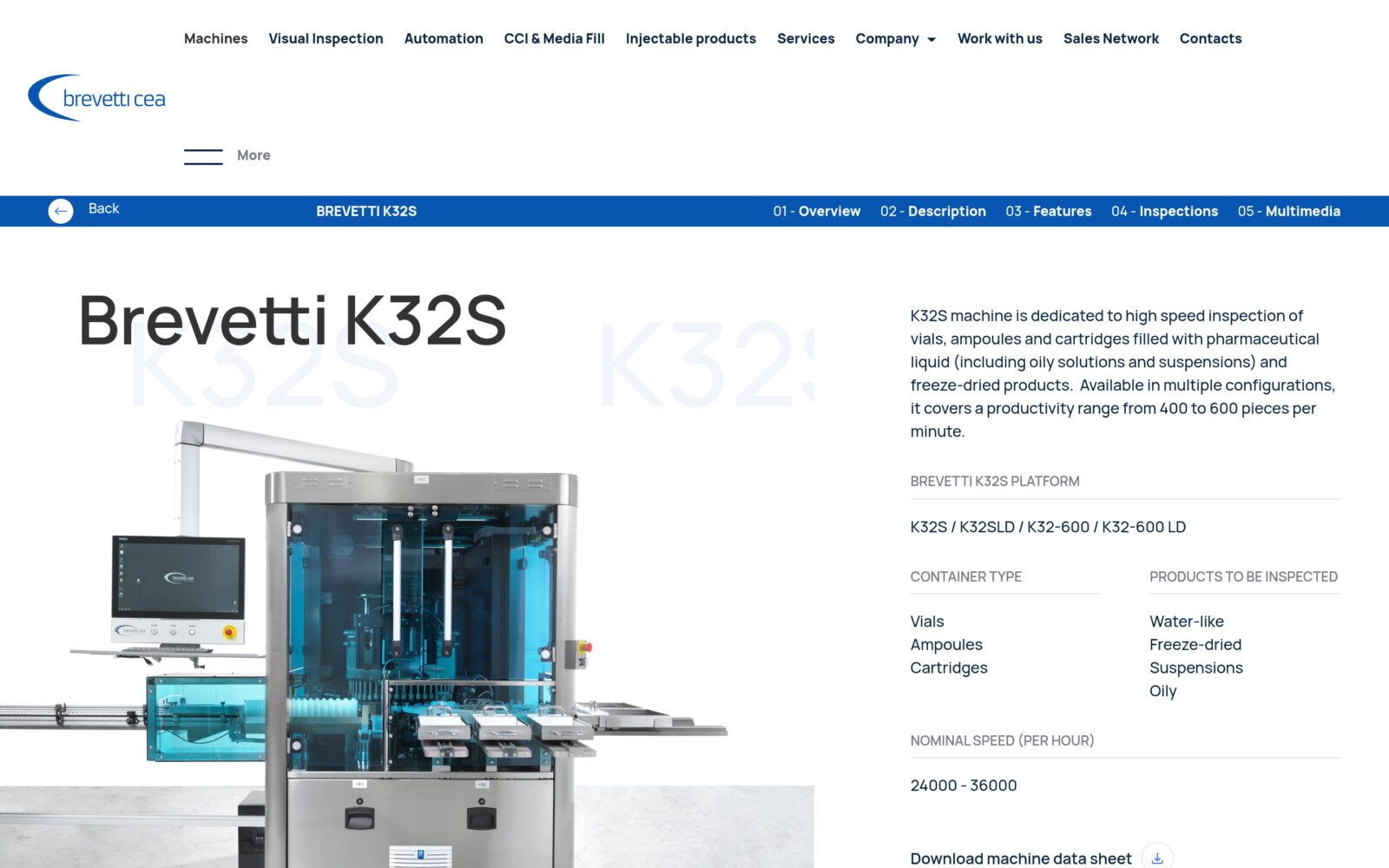
Where it shines: Brevetti automates formats most vendors don’t: plastic IV bags from 50 to 1,000 mL (IVB-40), blow-fill-seal (IBF) and large-volume parenterals. It also sells machines at 400–600 units per minute for syringes (K15, K15 DR) and for vials, ampoules and cartridges (K32S), most with high-voltage leak detection or headspace gas analysis built in.
Considerations: Brevetti builds its machines in Italy and serves the U.S. through a branch office in New Jersey. Its AI Suite trains on labeled images, so expect 8+ weeks to train a new recipe, and a 9–12 month lead time.
3. Körber (Seidenader): Best for high-speed and nested-syringe lines
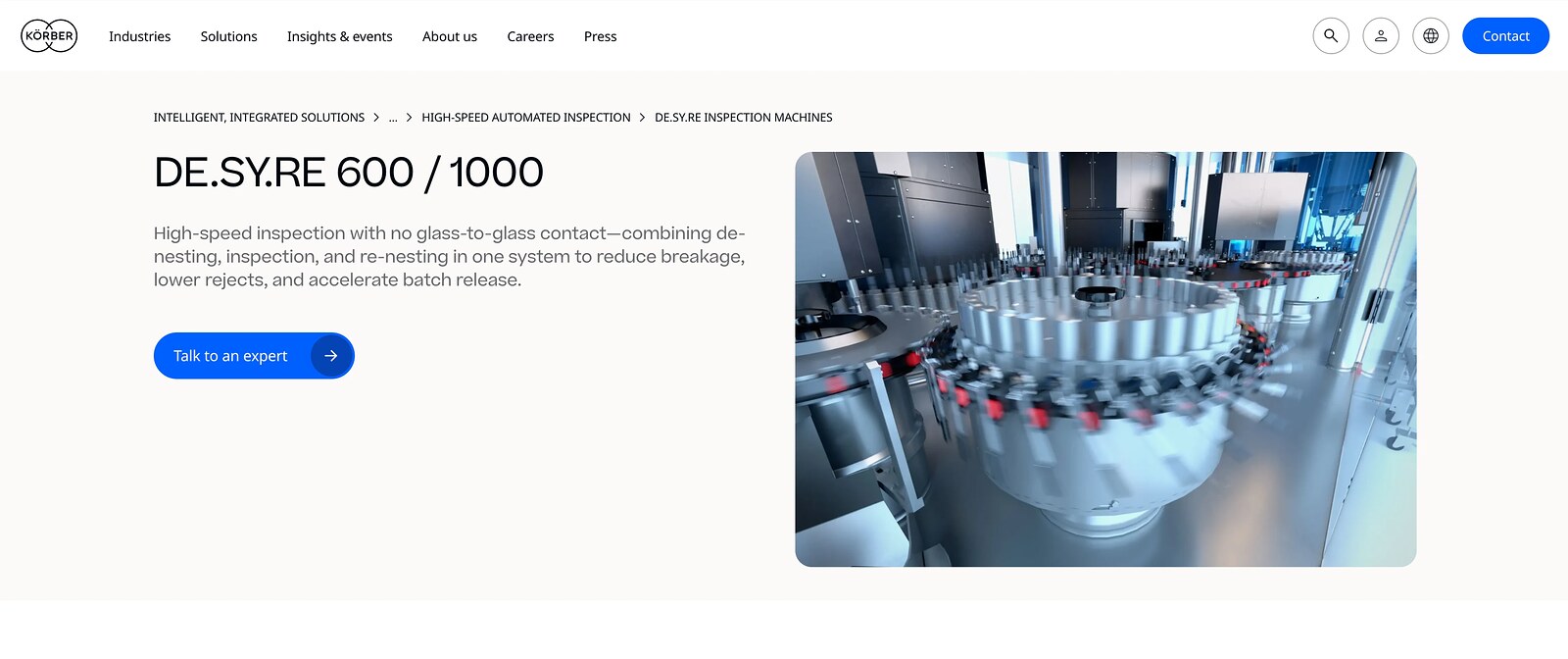
Where it shines: Körber sells its inspection machines under the Seidenader name, and its lineup is one of the broadest on this list: the VI, MS and CS at up to 600 units per minute, the VI-S and MS-S for prefilled syringes, the DE.SY.RE 1000 for up to 1,000 nested syringes and cartridges per minute, the Switch for small and large batches, and ALVA, a robotic machine for high-mix, low-volume syringe, vial and cartridge batches at about 20 per minute. High-voltage leak testing is an option on its main machines.
Considerations: Körber’s B.R.AI.N is supervised deep learning trained on classified images, typically with one model per product, format, machine and camera, and it needs tens of thousands of pre-labeled defect images before it runs in production. Its inspection machines are engineered in Markt Schwaben, Germany, with a U.S. entity in Fargo, North Dakota. Expect 10+ weeks to train a new recipe and a 10–14 month lead time.
4. Stevanato Group: Best for high-speed lines with fast changeover
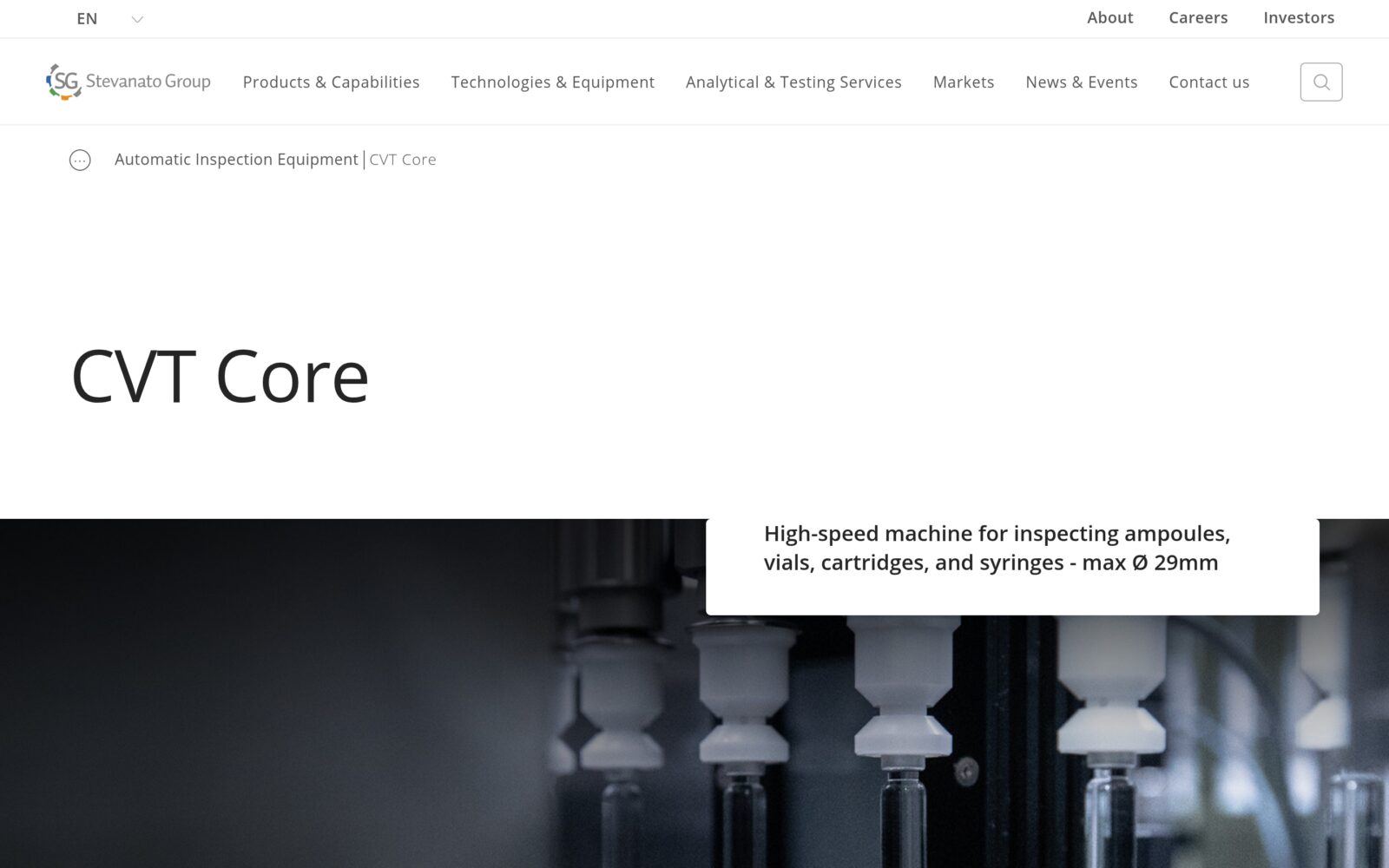
Where it shines: Stevanato’s CVT Series runs at up to 800 units per minute, the CVT Core at up to 600 and MAVIS at up to 400, across vials, ampoules, cartridges and syringes. Stevanato publishes a 15-minute changeover (two operators) on the CVT Core, and offers integrated high-voltage leak detection or headspace gas analysis and a deep learning AI platform.
Considerations: Stevanato’s AI models are built with its own team rather than by your staff. Expect 7+ weeks to train a new recipe and a 10–14 month lead time.
5. Antares Vision: Best for mid-speed vial and ampoule lines
Where it shines: Antares Vision’s VRI machines inspect vials at up to 400 units per minute, with a combined version that adds high-voltage leak detection, and a syringe version handles glass and plastic prefilled syringes at the same speed. Its Convel Tech range handles vials and ampoules at up to 350 units per minute, with leak detection built in. AI-GO adds deep learning models trained in the cloud and run at the edge.
Considerations: Expect 8+ weeks to train a new recipe and a 10–14 month lead time. Crane NXT completed its acquisition of Antares Vision Group on April 1, 2026.
6. WILCO EVO CAX: Best for small robotic vial batches
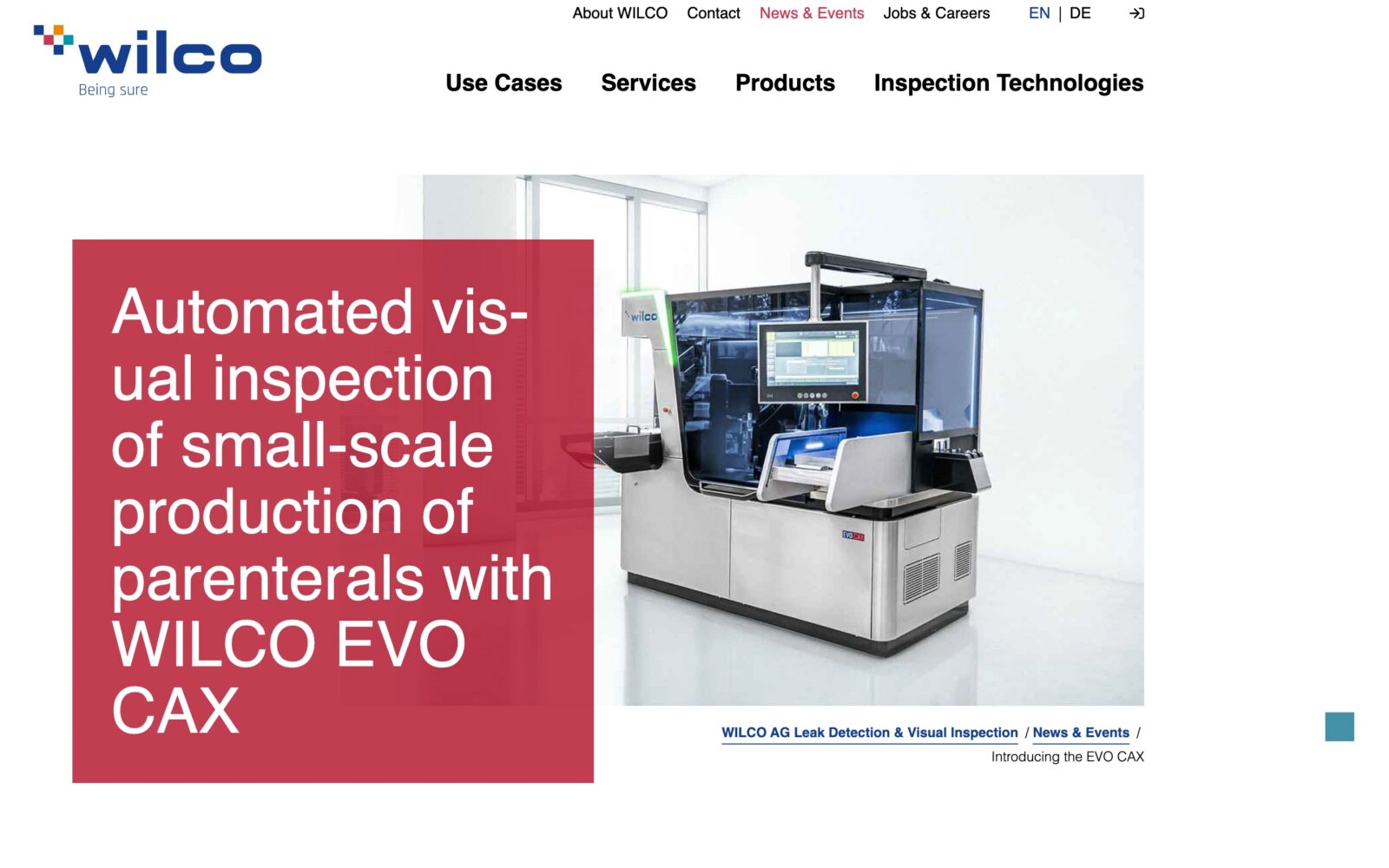
Where it shines: the EVO CAX is a robotic machine for high-mix, low-volume vial inspection at about 20 vials per minute. It handles liquid and lyophilized product in 2R–30R vials and uses what WILCO calls “AI-supported baselines” for recipe development. Its closest Körber equivalent is ALVA.
Considerations: It’s vials only. Expect 10+ weeks to train a new recipe and a 10–14 month lead time.
How to choose a Syntegon alternative
- Difficult-to-inspect products, or new products launching often: start with the Dabrico DAI-50.
- High-speed lines with fast changeover: Stevanato.
- IV bags, blow-fill-seal or large-volume parenterals: Brevetti CEA.
- High-speed and nested-syringe lines up to 1,000 per minute: Körber (Seidenader).
- Mid-speed vial and ampoule lines: Antares Vision.
- Small, vial-only batches: WILCO EVO CAX. If you also run syringes, cartridges or ampoules, the DAI-50.
Our verdict: for high-volume, clear-liquid production, the big high-speed vendors will all do the job. For products that are hard to inspect, the DAI-50 is the only machine on this list with published results, and the only one that trains a new recipe in under an hour instead of weeks, from good units only.
Send us your samples and we’ll show you the results. Dabrico runs feasibility studies on your own good and defective units, including on site with a portable DAI-50.
Frequently Asked Questions
Is Syntegon the former Bosch Packaging Technology?
Yes. Syntegon was Bosch’s packaging division until Bosch sold it to CVC Capital Partners. The sale closed on January 2, 2020, and the business was renamed Syntegon. It’s headquartered in Waiblingen, Germany, and its AIM5 inspection machines are developed and assembled in Japan.
Does Syntegon use AI?
Yes. Deep learning is an option on the AIM9, AIM2|5 and AIM DIRect, with models trained on classified images. In 2021 Syntegon installed what it calls the first fully validated AI inspection system, a syringe machine at Amgen.
What’s the closest alternative to the Syntegon AIM9?
For 600-per-minute vial lines with integrated leak testing, Brevetti CEA’s K32S, Stevanato’s CVT Core and Körber’s VI, MS and CS run at similar speeds, and Stevanato’s CVT Series goes up to 800. For difficult-to-inspect products like lyophilized cakes and powders in molded glass, the Dabrico DAI-50 builds a recipe from 500 good units in under 60 minutes.
Do I need labeled defect images to build a DAI-50 recipe?
No. Boon Logic’s AVIS platform trains on 500 good units. Syntegon’s optional deep learning trains on labeled defect images.
Which Syntegon alternatives include leak testing?
Brevetti CEA, Körber, Stevanato, Antares Vision and WILCO all offer integrated leak testing. The DAI-50 focuses on visual inspection and pairs with a stand-alone CCI tester.
How much does an automated visual inspection machine cost?
Prices depend on containers, speed, options and validation scope. As a guide, the DAI-50 runs about $500,000, while systems from the other vendors on this list typically start at $1 million to more than $2 million. Contact Dabrico for a DAI-50 quote.
Can we test our own product first?
Yes. Dabrico runs feasibility studies on your good and defective samples, including on site with a portable DAI-50.